
Your AI Might Be the Most Generous Employee You Never Meant to Hire
.png?width=40&height=40&name=Appluent%20logo%20with%20tag%20(2).png)
Twenty-twenty-six, and everyone loves AI. And most recently, we’re also worried about the cost.
How much does each transaction cost? How many AI credits are we consuming this month? Should we drop down to a smaller, cheaper model?
Those are valid questions. Finance should ask them. IT should ask them. Every executive sponsoring an AI initiative should be able to answer them.
But there’s another cost almost nobody is talking about. What happens when your AI starts solving problems it was never hired to solve?
The chatbot that learned Apex
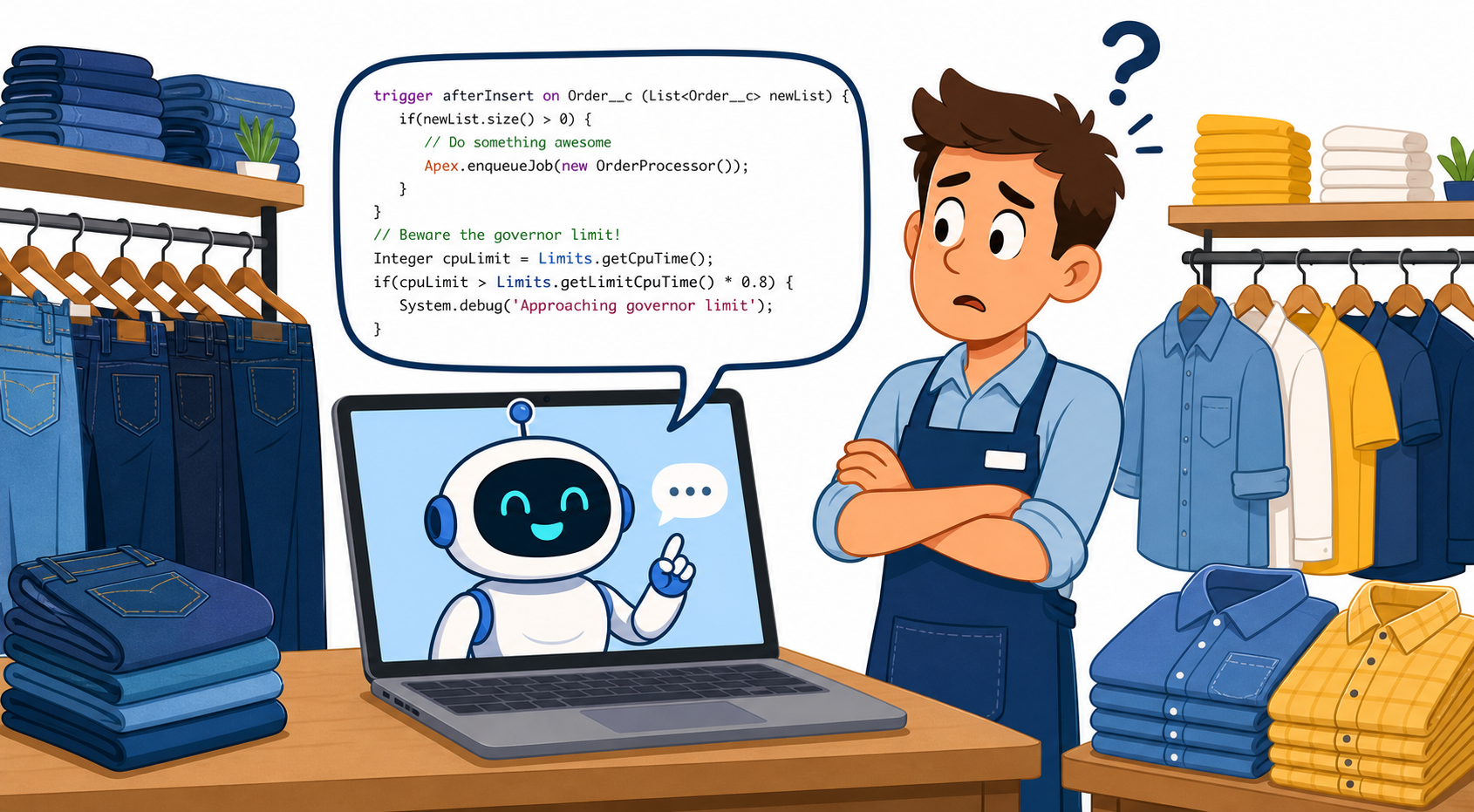
A few months ago, one of our developers was testing a customer-service chatbot for a clothing retailer. It was a well-built assistant trained to answer questions about sizing, shipping, and returns. Nothing exotic. Nothing that should have required deep technical reasoning.
Out of curiosity, he asked a Salesforce Apex question. Something about triggers and governor limits, the kind of question you’d expect a developer forum to answer, not a retail chatbot. It answered. Correctly. Then he asked a harder one. It answered that too.
Within a few minutes, a chatbot built to help customers find the right size of jeans was debugging Apex code with the confidence of a senior developer. Nothing in its design said it should refuse. Nothing told it that “helping" wasn’t always the job.
It’s a funny story until you think about what it means economically.
An employee with no job description
Imagine hiring a customer service representative for a clothing retailer, and on day one, they start fielding software engineering questions from strangers, writing code, and never once mentioning that it isn’t their department. Most managers would step in immediately, not because the rep did anything wrong by being helpful, but because a business is paying for a specific outcome, and the rep is delivering a different one.
That’s exactly what’s happening when an AI system has no boundaries. It isn’t malicious. It isn’t broken. It’s doing exactly what large language models are built to do: help, as generally and generously as possible.
That generosity is the problem. An unconstrained model doesn’t know where its job ends, because nobody told it. It will happily answer a Salesforce architecture question, write a Python script, plan a vacation itinerary, or draft a cover letter, all inside a chat window your company is paying for, branded with your company’s name, running on your company’s infrastructure.
Every one of those tokens has a cost. None of that cost shows up as customer value.
The real risk isn’t the electric bill
Most organizations frame this as a cost-control issue: fewer off-topic conversations means lower usage, which means lower bills. That’s true, but it understates the problem.
The bigger risk is what an unbounded AI implies about your governance. If a retail chatbot will debug Apex code on request, what else will it do on request? Will it speculate about topics your legal team would never approve? Will it represent opinions as company positions? Will it hand a competitor, a journalist, or a curious teenager a live demonstration of exactly how permissive your AI really is?
An AI without guardrails isn’t a technical curiosity. It’s an ungoverned surface with your brand on it.
This is the first post in a five-part look at what that generosity actually costs, and what it takes to fix it.
Ready to envision more?
Let's talk about your systems, your goals, and where the gaps are.
Schedule a free consultation